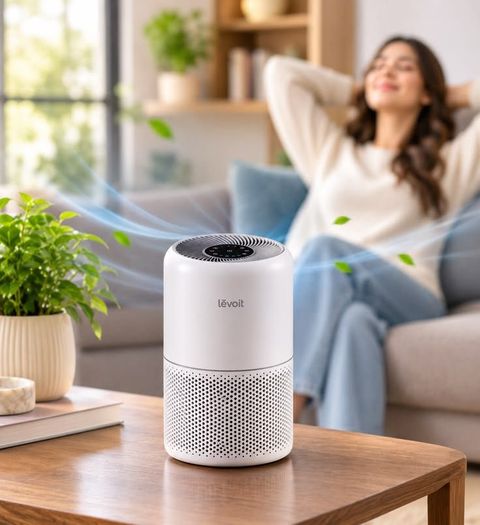
Do Air Purifiers Actually Work in Indian Homes? What to Check Before Buying
An air purifier may help reduce some of these pollutants indoors. But does it really work? Can it make a difference in a typical Indian home? And what should you check before spending money on one? The short answer is that a properly sized air purifier with an effective particle filter can reduce airborne particles in an enclosed room. However, it cannot remove every type of pollutant, clean the entire house automatically, or replace good ventilation and pollution-control measures.
Do Air Purifiers Actually Work?
Yes. Air purifiers can reduce certain airborne pollutants when they are correctly selected, placed, and maintained.
Most effective household air purifiers use a fan to pull room air through filters. The filters capture particles such as:
Fine dust and airborne dirt
PM2.5 and PM10 particles
Pollen
Some pet dander
Certain mould spores
Smoke particles
A purifier with a suitable high-efficiency particle filter can help lower the concentration of these pollutants in the room.
However, results depend on several factors, including the room size, purifier capacity, filter quality, fan speed, air leakage, and how long the unit runs.
An air purifier is not a complete solution to outdoor air pollution. It treats the air that passes through the machine, not every source of pollution entering the home.
Why Indoor Air Quality Matters in Indian Homes
Many people assume that staying indoors automatically protects them from polluted outdoor air. In reality, outdoor pollution can enter through windows, doors, balconies, and ventilation gaps.
Indoor activities can also add pollutants.
1. Outdoor Dust and Vehicle Pollution
Homes near busy roads may receive dust and particles from vehicle exhaust, road activity, and nearby construction.
Fine particles can enter through open windows and other gaps.
2. Cooking Smoke and Fumes
Cooking can release particles and gases into indoor air. Frying, grilling, and cooking with certain fuels can increase indoor pollution.
A kitchen exhaust system that sends fumes outdoors can help reduce this problem.
3. Dust From Furniture and Household Items
Carpets, curtains, mattresses, upholstery, and bedding can collect dust. Movement, cleaning, and daily activities can release some of these particles back into the air.
4. Cleaning Products and Household Chemicals
Some cleaning products, paints, adhesives, air fresheners, and fragrances release volatile organic compounds (VOCs).
A standard particle filter does not remove all these gases.
5. Pollen, Pets, and Mould
Pollen may enter through windows. Pets can release dander and other particles. Damp areas can encourage mould growth and release spores into the air.
An appropriate filtration system may help capture some airborne particles, but moisture problems and mould growth still need to be addressed at their source.
How Does an Air Purifier Work?
A typical air purifier uses a fan and one or more filters.
The fan draws air into the machine. The air passes through the filtration system, and the cleaner air is released back into the room.
Different filters perform different jobs.
1. Pre-Filter
A pre-filter captures larger particles such as hair, lint, and visible dust.
It helps protect the main filter from collecting larger debris too quickly. Many pre-filters can be cleaned or washed, but always follow the manufacturer's instructions.
2. HEPA Filter
A high-efficiency particulate air (HEPA) filter is designed to capture very small airborne particles.
A commonly recognised HEPA benchmark is at least 99.97% filtration efficiency for particles around 0.3 microns under specified test conditions.
This does not mean the purifier removes 99.97% of all pollution from an entire room in one pass. Real-world performance also depends on airflow, filter installation, room size, and operating conditions.
For homes affected by dust, smoke, and fine particles, a properly tested HEPA filtration system is one of the most important features to consider.
3. Activated Carbon Filter
Activated carbon is used to adsorb certain gases and odours.
It may help reduce some cooking smells, smoke odours, and chemical vapours. Its effectiveness depends on the amount and quality of carbon used.
A thin carbon-coated sheet may have limited capacity compared with a substantial carbon filter.
4. Additional Filters and Technologies
Some products include ultraviolet (UV) lights, ionisers, photocatalytic systems, or other technologies.
These features are not automatically necessary for good air cleaning. Check independent performance evidence and safety information before paying extra for them.
What Can an Air Purifier Remove?
Not every air purifier removes every pollutant. The filtration system determines what the device can handle.
| Pollutant | Can an air purifier help? |
|---|---|
| PM2.5 particles | Yes, with effective particle filtration |
| PM10 and household dust | Yes |
| Pollen | Yes, with suitable filtration |
| Pet dander | Yes, with suitable filtration |
| Smoke particles | Yes, with effective particle filtration |
| Cooking odours | Somewhat, if it has suitable activated carbon |
| Certain VOCs | Some reduction may be possible with an appropriate gas filter |
| Carbon monoxide | No, ordinary air purifiers are not a safety solution |
| Excess humidity | No |
| Mould growing on walls | No, the moisture source must be fixed |
| Carbon dioxide from breathing | No, ordinary air purifiers do not remove it |
This distinction is important. A purifier with a HEPA filter may capture particles but will not necessarily remove gases or unpleasant odours.
What to Check Before Buying an Air Purifier in India
Choosing a purifier should involve more than comparing brand names, prices, or the number of features. These are the main specifications worth checking.
1. CADR: Clean Air Delivery Rate
CADR stands for Clean Air Delivery Rate. It indicates how much filtered air a purifier can deliver over a period of time.
A higher CADR generally means the machine can clean a room faster, assuming comparable testing conditions.
For Indian homes, check the CADR rating before choosing a model.
Do not select a purifier only because its packaging says it covers a large area. Compare the stated CADR with the actual size of the room where you plan to use it.
2. Room Size and Coverage Area
Room size is one of the most important buying factors.
A small purifier may struggle to clean a large living room. A powerful unit in a very small room may be more expensive than necessary.
Measure the room's length and width to calculate its floor area.
For example:
Room length: 12 feet
Room width: 10 feet
Room area: 120 square feet
After calculating the area, check the purifier's recommended coverage and CADR.
Ceiling height also matters. A room with a higher ceiling contains more air than a room with the same floor area and a standard ceiling.
3. HEPA Filter Quality
Look for clear information about the filter type and its tested efficiency.
Be careful with vague terms such as "HEPA-type," "HEPA-like," or "HEPA-style." These labels do not necessarily mean the filter meets a recognised HEPA performance standard.
Check whether the manufacturer provides:
A clear filter specification
Independent test information
Replacement filter details
Information about the filter's expected service life
A reliable filtration specification is more useful than a long list of marketing claims.
4. Filter Replacement Cost
An air purifier is not a one-time expense.
Its filters need cleaning or replacement according to the manufacturer's instructions. In areas with heavy dust and pollution, filters may become dirty more quickly.
Before buying, check:
Price of replacement filters
Availability of genuine filters
Recommended replacement interval
Cost of additional pre-filters, if applicable
Whether replacement filters are easy to order
Compare the total cost over several years rather than looking only at the initial purchase price.
5. Activated Carbon Filter
If your main concern includes cooking smells, smoke odours, or certain household gases, check whether the purifier has an activated carbon filter.
Look for information about the amount of carbon used and the gases it has been tested to reduce.
A particle filter alone should not be expected to solve every odour or chemical pollution problem.
6. Noise Level
An air purifier may need to operate for several hours, including during sleep.
Check the noise level at different fan speeds. The lowest setting may be quiet but may also deliver less clean air.
If you plan to use the purifier in a bedroom, consider its noise performance at the setting needed to maintain suitable airflow.
7. Energy Consumption
Running a purifier for long periods can add to electricity use.
Check the rated power consumption and compare it with your expected daily operating hours.
For example, a 40-watt purifier running for 10 hours uses approximately 0.4 kWh of electricity. Actual consumption can vary by fan speed and operating mode.
8. Availability of Genuine Filters in India
Before purchasing, check whether replacement filters are available through the brand's official website or authorised sellers in India.
Some models may look affordable initially but have expensive or difficult-to-find replacement filters.
This can make long-term maintenance inconvenient.
9. Air Quality Sensor and Display
Some purifiers include sensors that show indoor particle levels.
These displays can help users understand changes in indoor air quality, but sensor accuracy and the type of pollutant measured vary.
Check what the sensor actually measures. A PM2.5 reading does not provide a complete picture of every indoor pollutant.
10. Ozone and Ioniser Safety
Be cautious about devices that generate ozone as part of their cleaning process.
Ozone can irritate the lungs and is not a safe substitute for effective particle filtration.
If a purifier includes an ioniser or another active air-treatment feature, check whether it produces ozone and review independent safety information. A straightforward mechanical filtration system can be a sensible choice for many households.
Which Air Purifier Is Suitable for Different Indian Rooms?
The right purifier depends on room size, pollution levels, occupancy, and usage.
| Room | What to consider |
|---|---|
| Small bedroom | Compact unit with adequate CADR and low noise |
| Large bedroom | Higher CADR and suitable coverage |
| Living room | Stronger airflow for a larger open space |
| Home office | Quiet operation and suitable room coverage |
| Kitchen | Outdoor-venting exhaust is important; a purifier is not a replacement |
| Children's room | Effective particle filtration, safe operation, and manageable noise |
For open-plan homes, consider the combined space rather than the area of one small section.
A single purifier may not clean multiple rooms effectively when doors are closed or airflow is restricted.
How to Use an Air Purifier Effectively
Buying the right machine is only the first step. Correct use also matters.
Place It in a Suitable Location
Keep the purifier in the room where people spend the most time.
Avoid placing it directly behind furniture, curtains, or other objects that block air intake and outlet vents. Follow the manufacturer's recommended clearance.
Run It Consistently
Running a purifier only for a few minutes may not provide much benefit.
During periods of poor outdoor air quality, operating it for longer periods can help maintain lower particle levels indoors.
Use a suitable fan setting based on room conditions and noise requirements.
Keep Doors and Windows in Mind
When outdoor pollution is high, keeping windows and doors closed can reduce the amount of polluted air entering the room.
However, homes still need appropriate ventilation. Follow local air-quality conditions and use safe ventilation practices when outdoor air is cleaner.
Clean or Replace Filters on Time
Check the pre-filter regularly and clean it only as instructed.
Replace the main filters according to the manufacturer's guidance. A clogged or damaged filter can reduce performance.
Control Pollution at Its Source
An air purifier works best as part of a wider indoor air-quality plan.
Useful steps include:
Using a kitchen exhaust fan that vents outdoors.
Avoiding indoor smoking.
Controlling dampness and repairing water leaks.
Choosing low-emission paints and household products where practical.
Reducing dust accumulation through regular cleaning.
Keeping vehicle and generator exhaust away from indoor air.
Common Air Purifier Buying Mistakes
Some common mistakes can lead to disappointing results.
Buying based only on price: A low-cost purifier may have limited airflow or expensive replacement filters.
Ignoring CADR: A purifier may have a good filter but insufficient airflow for the room.
Trusting every HEPA claim: Check the actual filter specification and supporting test information.
Expecting one machine to clean the entire house: Airflow between separate rooms is often limited.
Ignoring gas pollution: HEPA filtration does not automatically remove VOCs, carbon monoxide, or all chemical fumes.
Not checking filter availability: A purifier becomes difficult to maintain if genuine replacement filters are unavailable.
Expecting instant results: Indoor particle levels depend on room conditions, pollution sources, and how consistently the purifier operates.
Frequently Asked Questions
1. Do air purifiers work in Indian cities with high AQI?
Yes. A properly sized purifier with effective particle filtration can reduce airborne particles inside a room, even when outdoor air pollution is high. Results depend on room size, airflow, air leakage, and operating time.
2. Is a HEPA filter necessary for an air purifier?
For reducing fine airborne particles such as PM2.5, a properly tested high-efficiency particle filter is an important feature. Check the filter's actual specification rather than relying only on the word "HEPA" in product descriptions.
3. Should an air purifier run all night?
It can be operated overnight if the model is designed for continuous use and is maintained correctly. Choose a suitable fan speed that provides adequate airflow without creating too much noise.
4. Can an air purifier remove dust from furniture?
It can capture airborne dust particles that pass through its filtration system. However, it will not remove dust already settled on furniture, floors, or other surfaces. Regular cleaning is still necessary.
5. Can an air purifier reduce cooking smoke?
A purifier with effective particle filtration can capture some cooking-related airborne particles. An appropriate kitchen exhaust system is still important, especially when cooking produces smoke or fumes.
6. Does an air purifier remove carbon dioxide?
No. Ordinary household air purifiers do not remove carbon dioxide effectively. Proper ventilation is needed to manage indoor carbon dioxide levels.
7. How often should an air purifier filter be replaced?
There is no universal replacement schedule. It depends on the filter type, usage, pollution levels, and manufacturer's instructions. Check the filter indicator and maintenance guidance.
8. Is an air purifier enough to protect a family from air pollution?
No. It can be one useful part of an indoor air-quality plan, but it does not eliminate every pollutant or health risk. Source control, suitable ventilation, and other pollution-reduction measures remain important.
Conclusion
Air purifiers can make a meaningful difference to indoor air quality in Indian homes when they use effective filters and have enough capacity for the room.
Before buying, focus on CADR, room size, genuine HEPA filter specifications, activated carbon capacity, noise, electricity use, and replacement filter costs. Avoid choosing a model only because it has a smart display, multiple modes, or a popular brand name.
Most importantly, understand what the purifier can and cannot remove. It can help reduce airborne particles, but it cannot replace ventilation, kitchen exhaust, moisture control, or efforts to reduce pollution at its source.
A well-chosen and properly maintained purifier is best viewed as one part of a broader approach to cleaner indoor air.
This article is for general educational purposes. Air purifier performance varies by product and room conditions. It is not a substitute for medical advice or measures to reduce exposure to outdoor air pollution.

Related Post...
LPG vs. Induction: What It Really Costs a Family of Four Each Month
Updated: November 25, 2026
Read More
Can a Solar + Battery Setup Keep Your Home Running During Power Cuts?
Updated: November 25, 2026
Read More